There’s a point every fall when the calendar seems to speed up. Halloween isn’t even here yet, but Thanksgiving plans are starting to take shape. Holiday parties are appearing on calendars. Flights are being booked. Someone has probably already started Christmas shopping, and the rest of us don’t need that kind of pressure.
For some people, this is the best time of year. For others, the holidays are complicated. For a lot of us, they’re both.
Being single can add another layer. Maybe the traditions you once had belonged to a relationship that ended. Maybe your kids will spend part of the holidays somewhere else this year. Maybe you’ve lost someone who used to be part of every celebration. Maybe your friends disappear into family commitments for a few weeks. Or maybe you genuinely love your independence, have a full life, and still occasionally look around in December and think, Well, this feels a little quiet.
There’s room for all of that. But there’s also an opportunity in this season that we don’t talk about nearly enough: we have more say in what our holidays, our friendships, and our communities look like than we sometimes realize.
We don’t have to wait for someone else to make the plans.
The Holidays Have a Way of Turning Up the Volume
The holidays tend to magnify whatever is already there. Good relationships feel especially good. Loss can feel more noticeable. Traditions bring back memories. A busy social calendar can suddenly become very busy, while an empty weekend can feel unusually empty.
There’s research behind some of that complexity. In a national American Psychological Association survey, 89% of U.S. adults said something causes them stress during the holiday season, with missing loved ones, financial concerns and family conflict among the reasons. At the same time, 84% said the holidays create a sense of togetherness.
That combination makes sense. We can miss someone and enjoy the people sitting beside us. We can love a tradition and realize it doesn’t fit our life anymore. We can look forward to the holidays and still have moments when they feel hard.
Psychologist Krystine Batcho, who has studied nostalgia extensively, has written about the way nostalgia helps us maintain a sense of continuity through change. The people, music, food and traditions associated with the holidays can connect who we were with who we are now.
I like thinking about traditions that way. They don’t have to lock us into the past. They can give us something to carry forward while we decide what comes next.
And sometimes what comes next is something entirely new. If Friendsgiving sounds like exactly the kind of tradition you’d like more of, we’re getting together in Salt Lake City this November. Come with us.
Adult Friendship Requires a Little More Intention
When we were younger, life did a surprising amount of the work of friendship for us. We went to school with the same people every day. We played on teams. We had roommates. We hung around after class. We spent hours together without opening six calendars to find a Thursday three weeks from now when everyone was available.
Adult life isn’t usually structured that way.
University of Kansas researcher Jeffrey Hall studied how long it takes friendships to develop and found that moving from acquaintance to casual friend can take roughly 40 to 60 hours together. Becoming friends takes somewhere around 80 to 100 hours, while developing a close friendship can take more than 200.
That’s a lot of hours.
It’s also strangely encouraging.
Friendship isn’t necessarily something other people magically have and we somehow missed. A lot of it comes from time, proximity, repetition and continuing to show up.
The person you eventually call when you’ve had a terrible day might currently be someone you’ve talked to twice at a run group. Your future Friendsgiving table might include someone you haven’t met yet. The person you travel with next summer could be somebody you almost didn’t introduce yourself to this fall.
We rarely know which interactions are going to matter while we’re having them.
We just have to give them a chance to happen.
Somebody Has to Send the Text
There’s another piece of research I love because it addresses something most of us have probably done: thinking about reaching out to someone and then talking ourselves out of it.
Researchers led by University of Pittsburgh professor Peggy Liu conducted experiments involving more than 5,900 participants and found that people consistently underestimated how much others appreciated being contacted unexpectedly.
In other words, that person you’ve been meaning to text might actually be really happy to hear from you.
We tend to invent reasons not to do it. They’re probably busy. They already have plans. We haven’t talked in a while. Maybe it would be weird. They have their people.
Meanwhile, they may be sitting at home making the exact same assumptions about everyone else.
At some point, somebody has to go first.
This is one of the places where I think building community becomes less abstract. “Find your people” sounds lovely, but actual friendship is usually much less cinematic. It looks like sending the text. Inviting someone to dinner. Asking if anyone wants to go to a concert. Joining the group. Remembering someone mentioned they wanted to try that new restaurant and circling back two weeks later.
It also means accepting invitations. And occasionally saying yes before we’ve figured out exactly who we’re going with.
There Is Usually an Awkward Part
Getting outside our comfort zones sounds great in theory. In practice, it can mean standing in a parking lot for an extra three minutes before going inside.
There is a reason for that.
University of Chicago behavioral scientist Nicholas Epley has studied interactions between strangers and found that people often underestimate how much they will enjoy talking to someone they don’t know. In one series of experiments involving commuters, participants predicted that interacting with a stranger would be less pleasant than keeping to themselves. The people who actually had the conversations reported more positive experiences.
Our predictions about social interactions aren’t always particularly accurate.
That doesn’t mean walking into a room alone suddenly becomes comfortable. Sometimes it isn’t. Introducing yourself can still feel awkward. Joining an established group can take a little courage.
The useful part is realizing that discomfort doesn’t have to make the decision for us.
We can be nervous and introduce ourselves anyway. We can wonder whether we’ll know anyone and still sign up. We can sit in the car for those extra three minutes, finish whatever pep talk is happening in there, and then walk inside.
Getting outside our comfort zone doesn’t require becoming fearless.
Sometimes it just requires wanting the experience a little more than we want to avoid the uncomfortable first five minutes.
Community Is Built in Very Ordinary Moments
The U.S. Surgeon General’s guidance on social connection encourages people to invest consistent time in relationships and participate in community groups built around interests such as fitness, hobbies, service and other shared activities.
That recommendation is remarkably ordinary.
Run with people. Volunteer with people. Learn something with people. Eat with people. Play with people. Keep going back.
The first time you show up, everyone is new.
The next time, you recognize somebody.
A few weeks later, someone recognizes you.
Eventually, you walk into the room and there are people there who are glad you came.
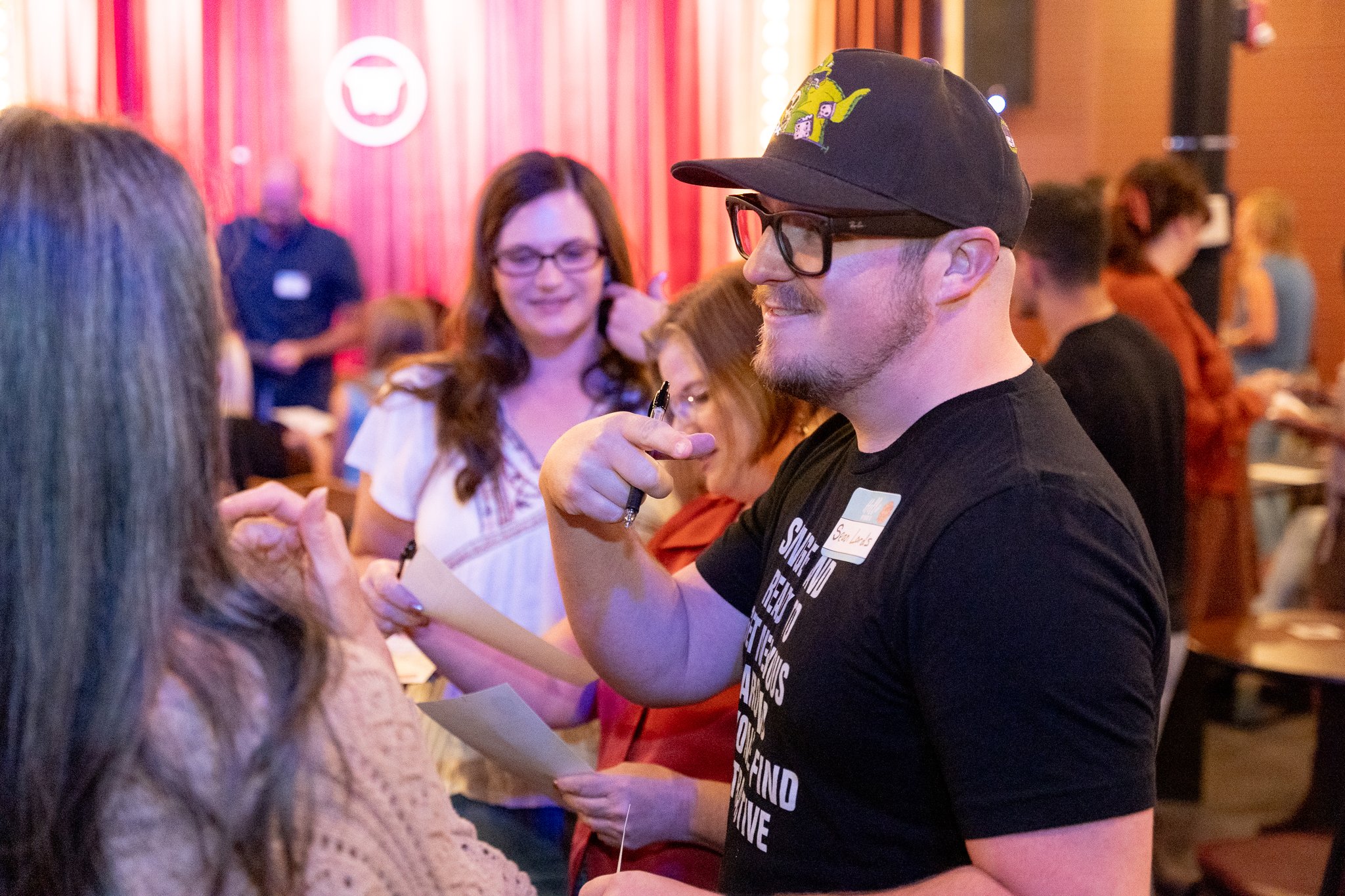
That’s one of the reasons I believe so much in doing things together. Sitting in a room and being told to mingle can feel like an assignment. Give us a game, a trail, a volleyball, something ridiculous to paint, a scavenger hunt or food to eat together, and suddenly we have somewhere to begin.
Play is powerful.
It gives us something to talk about besides ourselves. It lets us laugh before we know each other well enough to know what’s funny. It creates shared stories surprisingly quickly. It gives friendship somewhere to start.
The activity might not ultimately be the important part. But it can get us into the same room.
We Get to Make New Traditions
The holidays can make traditions feel like things that have always existed. But every tradition had a first year.
Someone hosted the first Friendsgiving.
Someone decided their friends were going to exchange ridiculous gifts every December.
Someone started the annual Christmas morning hike, holiday 5K, movie marathon, cookie exchange, weekend trip or dinner at the same restaurant.
There’s nothing stopping this year from being the first year of something.
That feels particularly important when life has changed. Divorce, widowhood, kids getting older, moving, changing relationships and simply getting older ourselves can rearrange traditions we assumed would always look the same.
We can grieve what changed and still create something we’re excited about now.
A holiday table doesn’t become less meaningful because the people sitting around it are friends instead of relatives. A tradition doesn’t need decades of history before it counts. And being single doesn’t put our lives on hold while we wait for someone else to arrive and help us create them.
We can start now.
Build the Life You Want People to Be Part Of
Social connection matters to our health. The U.S. Surgeon General’s advisory on social connection reports that social isolation is associated with a 29% increased risk of premature mortality. There is an enormous body of research showing that relationships and belonging matter to our physical and emotional well-being.
But fear of loneliness isn’t a particularly inspiring reason to build a life.
I think there’s a better one.
Life is better with people in it.
People to call and people who call us. People who notice when we haven’t shown up. People who talk us into doing something we probably wouldn’t have done on our own. People who make us laugh. People we get to show up for, too.
Some of those relationships will last for decades. Some will belong to a particular season of our lives. Someone we meet might eventually become a partner. Someone else might become the friend we text every Tuesday to see what we’re doing this weekend. And sometimes we’ll meet someone once, have a fantastic conversation and simply be glad our paths crossed.
We don’t have to know which one it will be before we say hello.
The holidays are coming. There may be moments this season that feel different than we expected. There may be people we miss, traditions that have changed or invitations we wish had come.
And there is still a lot ahead of us.
We can make the invitation. Accept one. Put something on the calendar. Try the thing we’ve been talking ourselves out of. Start a tradition. Become a regular. Walk into a room where we don’t know anyone yet.
Maybe something life-changing happens.
Maybe we laugh really hard.
Maybe we meet someone.
Maybe we make a friend.
Maybe we just have a really good night.
All of those sound like pretty good reasons to go.
Ready to put something on the calendar?
We’re getting together for walks, games, dinners, adventures and plenty of reasons to leave the house. See what’s coming up and come with us.
Sources
- American Psychological Association, Even a joyous holiday season can cause stress for most Americans
- Jeffrey A. Hall, University of Kansas, research on the number of hours required to form friendships
- Peggy Liu et al., The Surprise of Reaching Out: Appreciated More Than We Think
- Nicholas Epley and Juliana Schroeder, research on interactions with strangers
- U.S. Surgeon General, Our Epidemic of Loneliness and Isolation
- Krystine Batcho, PhD, research on nostalgia and psychological well-being